

NATO summit gives Europe and Turkey a strategic reset opportunity
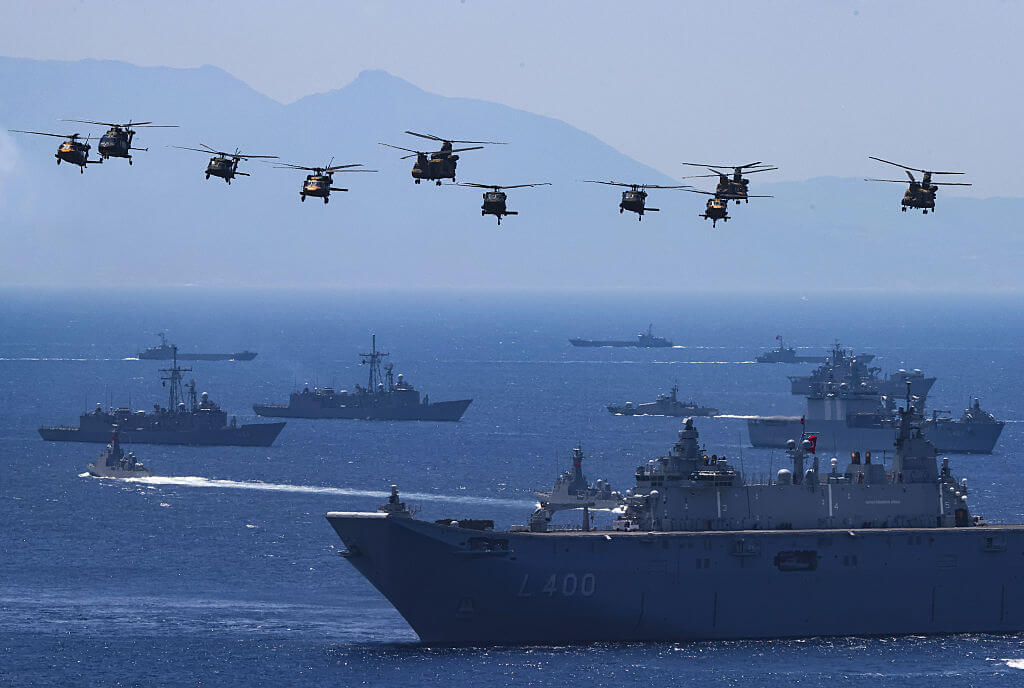

This week’s NATO summit in Ankara provides a historic opportunity for the European Union and Turkey to reset their fraught relationship around a strategic security and defence partnership after a decade of deteriorating ties.
Russia’s war of aggression against Ukraine, Donald Trump’s disengagement from European security and China’s growing geopolitical challenge are all pushing Brussels and Ankara closer together.
So European leaders should hold their noses, swallow their pride and offer President Recep Tayyip Erdoğan incentives to cooperate rather than continuing to ostracise him over his baleful human rights record.
Turkey, which secures NATO’s southeastern flank and controls access to the Black Sea, is too strategically important to exclude. Besides, by suspending its long-stalled accession negotiations and stalling closer trade ties, the EU has weakened pro-European Turks without achieving any improvement in Erdoğan’s domestic behaviour.
On the contrary, the authoritarian leader, in power since 2003, has amplified his state capture and crackdown on political opponents, civil society activists and journalists. Keeping Turkey in quarantine may salve European consciences but it is a failed policy. The EU must put its security interests before high-minded liberal principles and give closer cooperation with Ankara a chance.
The reasons are self-evident. Turkey – a nation of 91 million – has the largest European army in NATO and is vital to containing Russia, supporting Ukraine and stabilising the border between Europe and the Middle East. It is the main gatekeeper to Europe, housing some 2.3 million Syrian refugees as well as tens of thousands fleeing Iran and Afghanistan, who would otherwise flood into the EU. And it has a strong defence industry that could boost Europe’s rearmament drive.
There is also much hypocrisy in Europe’s treatment of Turkey. For example, criticising Ankara for its dependency on Russian gas and nuclear power while simultaneously shutting it out of Eastern Mediterranean energy cooperation makes no sense.
Turks have a fair point when they complain that the EU never really wanted such a large, predominantly Muslim nation as a member – former French and German leaders Nicolas Sarkozy and Angela Merkel said so openly. Yet there is a vast potential for more constructive relations between the current mutual suspicion and obstruction, and the improbable goal of EU accession.
The EU needs to be more transactional about what mutual benefits can be attained. It could offer Ankara an enhanced customs union and the opportunity to access the EU’s defence market, perhaps including the Commission’s Security Action for Europe (SAFE) joint procurement loans on favourable terms, in return for Turkey lifting its longstanding blockade on EU-NATO cooperation.
Ankara would have to sign a security and defence partnership with the EU, as the UK and Canada have done – even if the obligatory clause about democracy and the rule of law is a farce – and pay to play in order to access the SAFE loans. In return, its defence sector would be able to compete and partner with European companies for joint procurement projects.
The elephant in the room is the historic Cyprus conflict, which has gummed up defence cooperation, as well as Turkey’s attempts at European rapprochement. Cyprus and Greece have leveraged their EU membership to block closer ties with Ankara. For their part, the Turks have used their NATO membership to prevent, for example, sharing classified information with the Union. We can no longer afford such mutual obstruction.
There are other obstacles, including historic Greek-Turkish disputes over maritime boundaries in the Aegean Sea, and deep suspicion, especially in France, of Erdoğan’s ties to the Muslim Brotherhood and encouragement of the Islamisation of immigrant communities in Western Europe. Moreover, the “Blue Homeland” maritime expansion doctrine, which Erdoğan’s government wants to turn into law, poses a threat to Turkey’s neighbours.
It may be far-fetched to hope that a warming of Turkish-EU relations would make a settlement of the Cyprus problem – a frozen conflict ever since Turkey’s 1974 invasion of the divided island – any more likely. Reuniting Cyprus has defeated some of the finest diplomats, including Kofi Annan and Richard Holbrooke, and the Greek Cypriots who attained EU membership in 2004 despite voting down Annan’s peace plan, have the whip hand to thwart rapprochement with Ankara.
Yet it would be a mistake for Europe to miss the opportunity for a reset with Turkey at a moment when Erdoğan, recognising that Russian President Vladimir Putin’s power is ebbing and that the Middle East power balance is shifting, has moved closer to the West.
All sides would benefit from an EU-Turkey rapprochement. It might even encourage Turkey’s oppressed democrats and minorities, who have gained nothing from the current stalemate.
This op-ed was originally published by Euractiv.
Paul Taylor is a Senior Visiting Fellow at the European Policy Centre.
The support the European Policy Centre receives for its ongoing operations, or specifically for its publications, does not constitute an endorsement of their contents, which reflect the views of the authors only. Supporters and partners cannot be held responsible for any use that may be made of the information contained therein.