

How German state elections can shift EU politics


Recent polls suggest that the Alternative für Deutschland (AfD) party is set to win ballots in regional elections in the state of Sachsen-Anhalt on Sunday 6 September. Sachsen-Anhalt is one of Germany’s 16 federal states with a population of just above two million people in a country of around 84 million inhabitants.
The AfD, a key driver of the ‘Europe of Sovereign Nations’ group in the European Parliament, has already established itself as Germany’s largest opposition party at federal level. The party is anti-euro, advocates ‘re-migration’, and has ties to Putin’s Russia. Its regional branch in Sachsen-Anhalt was classified as ‘right-wing extremist’ by the Office of the Protection of the Constitution in 2023. According to recent polls, the AfD is likely to gain more than 40 per cent of the vote in Sachsen-Anhalt. Under certain conditions related to German electoral law, with a 5 per cent threshold for parties to enter parliament, this could even translate into an absolute majority, allowing the AfD to form a government single-handedly in the regional capital, Magdeburg, where the CDU has led coalition governments for more than 20 years.
In subsequent regional elections in Mecklenburg-Vorpommern and Berlin on 20 September 2026, the party is again likely to score highly, but building coalitions to form the next governments is likely to be easier.
These regional elections have to be seen in a wider political context. They will have a profound impact on the political landscape of post-World War II Germany. They are likely to demonstrate significant electoral support for a party that challenges the very foundations of the German constitution and weaken Chancellor Friedrich Merz (CDU) and his governing coalition with the Conservative sister party of Bavaria (CSU) and the Social Democrats at federal level in Berlin. They will also make it more difficult for Germany to build majorities for much-needed economic and social reforms in the months ahead.
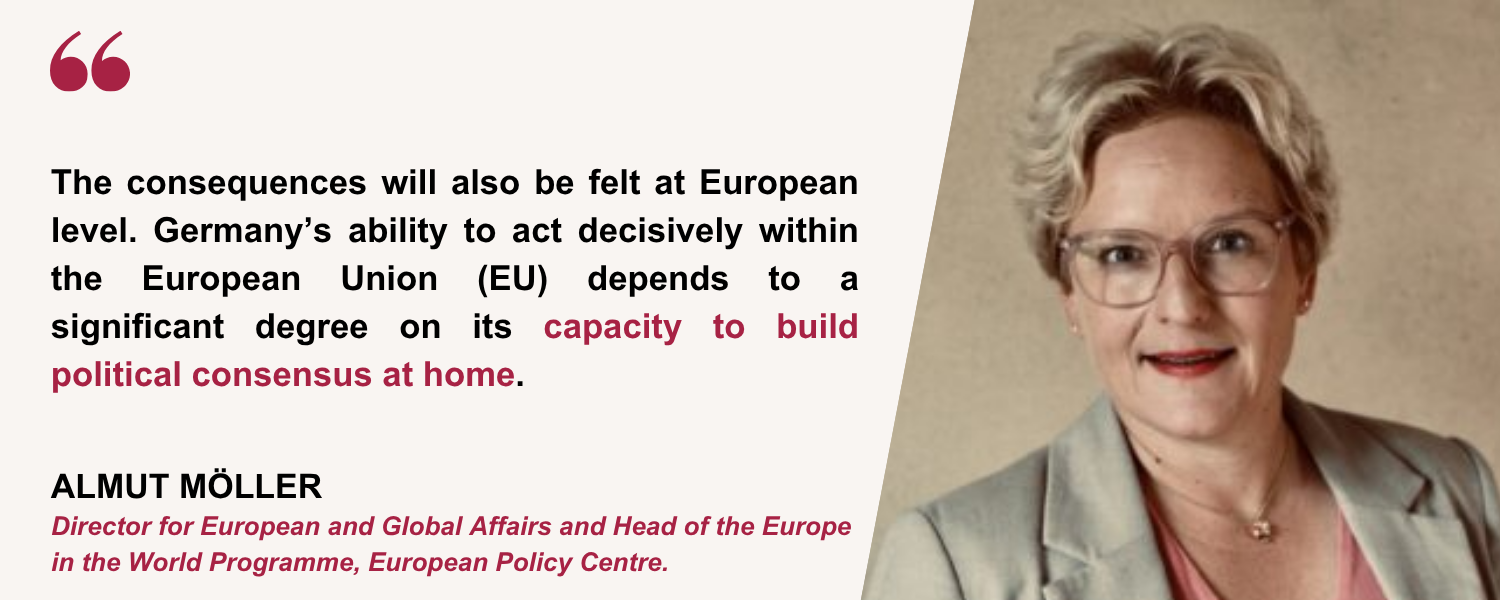
The consequences will also be felt at European level. Germany’s ability to act decisively within the European Union (EU) depends to a significant degree on its capacity to build political consensus at home. The September elections will expose tectonic shifts in Germany’s political landscape at a time of regional and global upheaval.
Why regional elections matter nationally
An important aspect that is not well-known is how the federal and regional layers are intertwined in the German federal system. The 16 federal states play a key role in Germany’s legislative processes at the national level. The Bundesrat, the chamber of the 16 federal states, tables every piece of legislation of the German national parliament, the Bundestag. The power of the Bundesrat to merely comment on, amend, or block draft Bundestag legislation varies, depending on the demarcation of competencies enshrined in the German constitution.
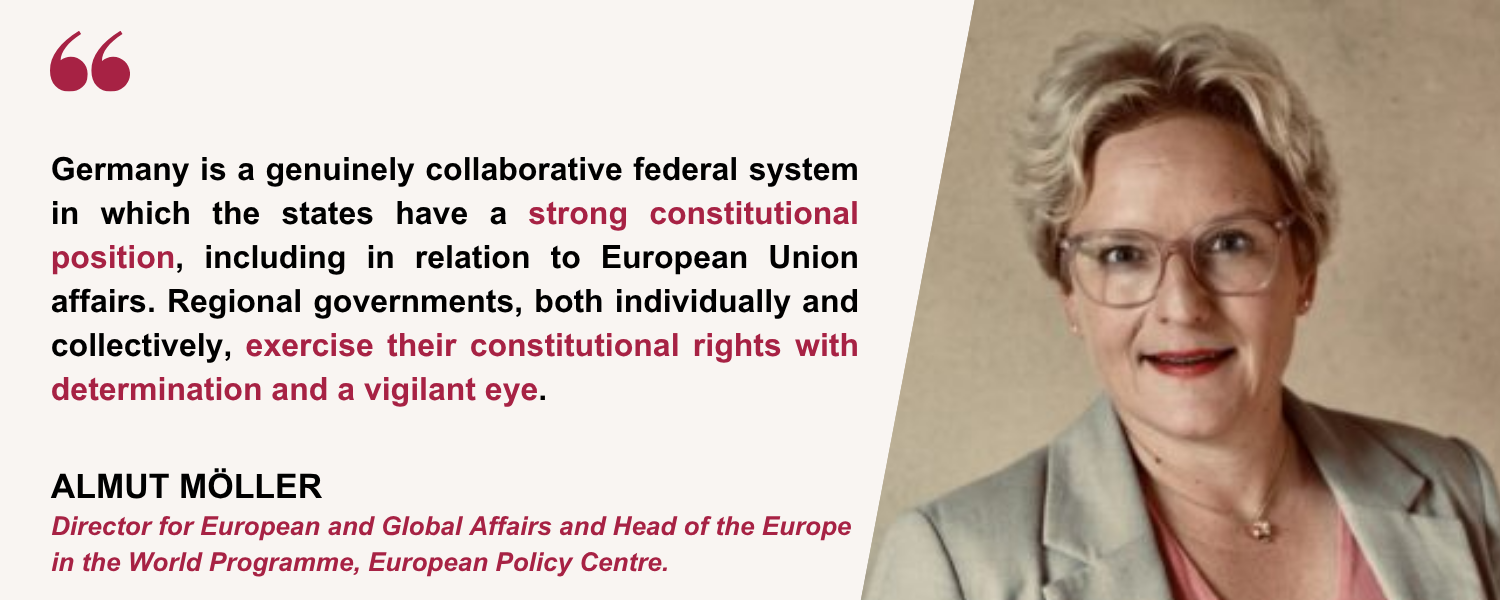
Germany is a genuinely collaborative federal system in which the states have a strong constitutional position, including in relation to European Union affairs. Regional governments, both individually and collectively, exercise their constitutional rights with determination and a vigilant eye.
Therefore, in key policy areas, including economic and social policies, the national level needs to ensure that majorities in both chambers are secured in support of federal legislation. As a result, considerable political coordination takes place across federal and regional levels, regularly involving the highest political ranks before legislation reaches the respective plenaries. The composition of regional governments can consequently have a direct impact on the federal government’s ability to legislate.
The fragile arithmetic in the Bundesrat
The Bundesrat comprises 69 votes in total, with each state receiving between three and six votes under a system of degressive proportionality, similar to the EU’s co-legislators. Mecklenburg-Vorpommern, for example, has three votes, while North Rhine-Westphalia has six.
A majority requires 35 votes. Crucially, however, the votes of an individual state cannot be split: a coalition government must agree on how all of its votes are cast. If its parties cannot agree, the state effectively has to abstain, which amounts to a “no” on legislation requiring Bundesrat approval. Over the years, the Bundesrat has become increasingly diverse, with 15 federal states run by coalitions of all kinds of political colours at present, leaving only the Saarland as a one-party government. Four more federal states are composed of coalitions mirroring the federal government. Yet, even taken together, these do not have a majority, and even the same political parties might not always support specific national legislation.
This makes the Bundesrat a chamber in which compromise and, therefore, political trust, matter enormously. Majorities have to be assembled across party lines, often only after extensive negotiations, and, as a last resort, through mediation committees involving the highest-level regional leaders and members of the Bundestag.
Unlike the Bundestag, where the AfD has been represented since 2017 and is now the largest opposition party, the party has so far never participated in a regional government. That could change if it wins an absolute majority in Sachsen-Anhalt. The political significance of such a development would far exceed the representation of this small federal state at national level.
A shock to Germany’s political centre
An AfD-only government in Sachsen-Anhalt would not, by itself, give the party the power to forge Bundesrat majorities given the state has only four of the chamber’s 69 votes. But the political shock would nevertheless be considerable.
The Bundesrat remains, in many respects, a chamber of the ‘old’ Federal Republic: a place where political differences may be substantial in an ever more diverse landscape of coalition governments, but where compromise has traditionally prevailed, and where the idea of holding the country together from Munich to Schwerin still carries considerable weight. Personal trust remains an important, often invisible component of this system.
An AfD-led government would fundamentally challenge that political culture. The AfD would certainly use all its parliamentary rights, including the right to speak, in a strategic manner well beyond the chamber. The party would bring the confrontation that has increasingly characterised German federal politics into a parliament traditionally defined by intergovernmental cooperation and a quiet quest for compromise. Given the AfD’s strong representation in the Bundestag, this will likely further complicate efforts to build majorities for joined legislation.
If the AfD falls short of an absolute majority, this would still mean a prolonged period of uncertainty. With the possible exception of the Bündnis Sahra Wagenknecht (BSW), which may itself struggle to cross the five-per-cent threshold, the other parties have ruled out cooperation with the AfD. Yet forming a government without the AfD could also prove difficult. Depending on the final distribution of seats, a coalition of the remaining parties could require cooperation between political forces with deep ideological differences, particularly the CDU and the Left Party.
During this transition period, the outgoing government would remain responsible for representing its federal state in the Bundesrat, but as a politically weakened caretaker administration with limited legitimacy to take positions on highly contentious federal legislation currently discussed. While subsequent elections in Mecklenburg-Vorpommern and Berlin are likely to be less dramatic, there will still be similar transition periods for coalition negotiations until the new governments take office. That again will impact the room for manoeuvre of the federal government in Berlin on key policy reform proposals it aims to complete before the end of the year.
Implications for the federal government
With immense pressure on Chancellor Merz and his coalition government to bring the German economy back on track and to ensure that pension and health systems are up to task in an increasingly challenging demographic environment, the capacity of the national level to legislate is essential. Majorities in the Bundestag so far have been solid, but Chancellor Merz is facing ever lower public approval. Keeping the coalition partners, the CDU/CSU and the SPD, together has become a serious balancing act for the coalitions partners and their respective parties. The September elections are likely to intensify that pressure.
A strong AfD showing will provide the opposition with additional political momentum while exposing the governing parties to further electoral losses. The three regional elections, to varying degrees depending on eventual election results, will also make the interplay between the Bundestag and the Bundesrat more difficult precisely when the federal government needs to move quickly on economic and social reform. The Bundesrat would still be able to assemble the necessary 35 votes, albeit in an overall more adversarial setting. But doing so will become more politically costly, more unpredictable and more dependent on last-minute compromise which requires high-level political attention.
Why this matters to the EU
Germany remains a country that is key to the EU’s economic, political, and increasingly, security and defence power.
Over the past years, German politics have become increasingly fragmented and polarised, while the pressure for fundamental reform of the country has mounted. The September 2026 elections are very likely to bring this trend into unprecedented focus, but they are only the tip of the iceberg. In recent nation-wide polls, the AfD scores almost 30 per cent, coming in first, ahead of Chancellor Merz's CDU.
The upcoming regional elections will not mean that Berlin’s engagement at EU level will change overnight. The federal government will remain committed to supporting Ukraine and re-building European security and defence, for example. Having said that, the German government will increasingly need to be understood through the lens of a fragmenting political centre trying to push back against a serious political threat from the extreme right, and fighting to re-gain electoral trust.
The impact at EU level will be indirect. The AfD’s successful narrative of ‘But what is in it for us, the Germans?’ has already trickled down into the wider German discourse. If the federal government fails to politically engineer fundamental reform of Germany’s economy and social systems because of political blockades, it will continue to be the target of electoral dissatisfaction, and the extreme right is likely to rise further. Fundamentally, this will mean a weaker and more divided Germany. This does not bode well at a time when the EU has to take key decisions to secure its competitiveness and innovation, the long-term EU budget, and European security.
Almut Möller is Director for European and Global Affairs at the EPC. From 2019-2024 she served as State Secretary and Plenipotentiary of the Free and Hanseatic City of Hamburg to the Federation, the EU, and for foreign affairs.
The support the European Policy Centre receives for its ongoing operations, or specifically for its publications, does not constitute an endorsement of their contents, which reflect the views of the authors only. Supporters and partners cannot be held responsible for any use that may be made of the information contained therein.