

EDF 2.0: Keeping research at the heart of Europe’s defence drive

The European Defence Fund (EDF) was launched in 2021, a year before Russia’s full-scale invasion of Ukraine, in an effort to remedy decades of chronic underinvestment and fragmentation in defence research and development in Europe. It aims both to close critical capability gaps and to accelerate the transformation of defence by attracting new and non-traditional players.
This peacetime instrument has become even more vital in turbulent geopolitical times. Yet while member states are committed to increasing their defence spending substantially over the next decade, including by leveraging the common EU budget, the shape of future research and development (R&D) funding remains uncertain given the increased focus on meeting immediate operational needs.
The European Commission’s White Paper – Readiness 2030 defined twin objectives of closing critical capability gaps and transforming defence through disruptive innovation. An enhanced and increased defence research funding instrument is a key part of achieving the latter goal.
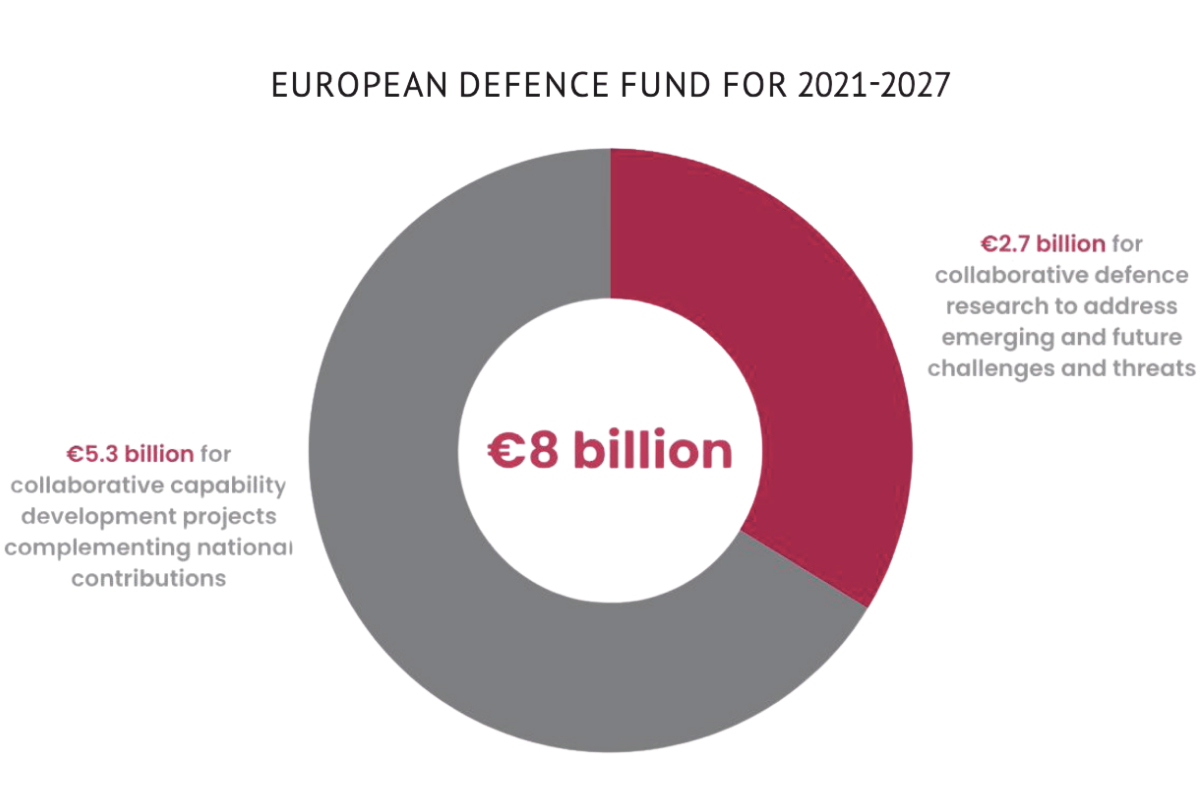
With a budget of €8 billion for 2021–2027, the EDF has become a central instrument for promoting joint R&D, fostering innovation and stimulating cross-border industrial cooperation. It is the third-largest defence R&D budget in the EU after those of Germany and France, representing 15% of all defence R&D funding in the bloc and about 50% of all collaborative defence research in the EU. It has so far funded 224 projects involving some 700 entities. Small to medium-sized enterprises (SMEs) account for 43% of beneficiaries and have received roughly 20% of the funds, highlighting the important role of smaller enterprises. Of the total, €2.7 billion was allocated for collaborative defence research and €5.3 billion for collaborative capability development projects intended to complement national contributions.
After five years of operation, disbursing about €1 billion a year, the European Commission conducted an interim evaluation of the EDF as it was developing a more ambitious strategy to boost the European Defence Technological and Industrial Base (EDTIB). European nations are under pressure to accelerate rearmament to support Ukraine, counter Russia’s increasing hybrid warfare against the EU and prepare for the growing risk of high-intensity conflict. Europe needs to shorten the time-to-market for defence innovation, balancing urgent capability needs with longer-term investment to preserve its technological edge.
The Commission proposes to finance defence R&D in the next Multiannual Financial Framework (MFF) from 2028–2035 as part of a jumbo €410 billion European Competitiveness Fund, which would encompass existing EU defence instruments, civilian research programmes and support for strategic industries. The aim is to reduce duplication, simplify procedures and close the innovation gap with the United States and China by directing large-scale investment to strategic sectors. Of the total, €125 billion would be earmarked for defence and space.
Whether member states will agree to such a large sum for common defence spending remains to be seen in the forthcoming budget negotiations. They should do, given Europe’s deteriorated geopolitical position. However, in the last MFF, the Commission’s initial proposal of €11.45 billion for the EDF was cut to €7.01 billion, and funding for military mobility was slashed from €5.76 billion to €1.5 billion.
The EDF has proven complex to implement. Critics say it lacks strategic direction and is constrained by annual budgeting, which makes it impossible to provide binding funding commitments beyond one year, only an “indicative multiannual perspective”. It is also hampered by the lack of co-financing from member states, which undermines continuity and limits industry incentives to invest, as it is uncertain if the supported activity will continue.
No EDF project had yet been completed by the time of the Commission’s June 2025 evaluation. While officials and researchers note that several projects have produced significant results, these remain largely unknown outside specialist circles, as security classification limits dissemination. Greater visibility of the EDF’s achievements could nonetheless help persuade member states to support a more ambitious second round of EU defence R&D funding.
Defence industries rely both on innovation, as illustrated in the Russia-Ukraine war, and on deep tech knowledge. That requires the involvement of agile SMEs and research institutions. It is essential that defence research does not become disconnected from development and production in the rush to transform ideas and innovation into capabilities. Otherwise, the risk is that the needs of today crowd out the needs of tomorrow.
Read the full Policy Brief here.
Paul Taylor is a Senior Visiting Fellow in the Europe in the World Programme and a member of the Defence/Security EUrope project.
The support the European Policy Centre receives for its ongoing operations, or specifically for its publications, does not constitute an endorsement of their contents, which reflect the views of the authors only. Supporters and partners cannot be held responsible for any use that may be made of the information contained therein.