


Reflections on the European Rule of Law Talks 2026






Introduction
Europe is currently navigating a period of profound disruption, both internally and externally, where the rule of law has shifted from a foundational principle to an active battleground. Rising security threats, the weaponization of technology against democratic institutions, the EU’s enlargement process and tense budget negotiations are all testing the consistency and credibility of Europe’s commitment to its core values.
Against this backdrop, re:constiution and Connecting Europe at the European Policy Centre co-organized the European Rule of Law Talks 2026 in Brussels on 22 September 2026. The event brought together a diverse group of policymakers, academics, journalists and civil society representatives to discuss the current state of the rule of law and its role in shaping Europe’s future. The four side sessions provided a platform for exploring critical themes, fostering open, interdisciplinary, and often controversial debates.
This follow-up publication, featured here and on TrafoBlog, builds on these discussions by compiling reflections and insights from session participants to extend the conversation beyond the event.
Rule of law in EU Enlargement: what is missing is credibility, not new tools
Eric Maurice, Policy Analyst in the European Politics and Institutions Programme, European Policy Centre
Marta Riggio, Project Assistant in the Connecting Europe Programme, European Policy Centre
From a civil-society perspective, expanded rule of law monitoring is welcome and useful, but it is not working well enough to drive reform. Extending the EU Rule of Law Report to all candidate countries could increase scrutiny, provide comparative evidence and strengthen reform pressure. In practice, however, monitoring remains fragmented: a participant pointed out that the Rule of Law Report and the Annual (Enlargement) progress reports operate as “separate exercises and are poorly interlinked”.
The instruments themselves are also weak. A RESILIO-ACCESS mapping finds that roughly two thirds of EU rule of law instruments carry no real consequence. None specifically target state capture, benchmarks go unchecked once set and instruments arrive too late to matter. The EU has many tools but little bite.
Participants pointed to deeper structural problems: EU tools assume cooperative governments, yet in several candidate countries “the government itself is the problem”. Reports are becoming increasingly performative, with weak recommendations. Some participants also perceived that local EU delegations avoid being too critical of the government or raising hard questions, operating on a “we must push enlargement forward” logic. In their view, this leads delegations to press civil society organisations (CSOs) to legitimise processes by participating in them rather than to scrutinise them.
Credibility then becomes a structural problem, and it raises a pointed question: Does the rule of law framework risk becoming a tool of legitimisation rather than of genuine reform? Instruments only work if the membership promise is believed, hence their weakness in stalled accession processes.
To address this credibility problem, participants recommended to institutionalise civil-society input in the Rule of Law Report: involve CSOs even where governments are uncooperative, make both government and CSO positions transparent and enable shadow reports by candidate-country CSOs with direct, independent channels to EU institutions and European Parliament committees.
Participants also called for better timing and communication of the reports: abandon the summer publication cycle that suits governments and suppresses debate, and improve in-country presentation so governments cannot cherry-pick findings or blur the two reports.
Finally, the EU needs to shift its focus from adopting reforms to implementing them. It should verify that reforms are applied in practice and broaden its assessment to cover civic space and internal democracy within parliamentary parties.
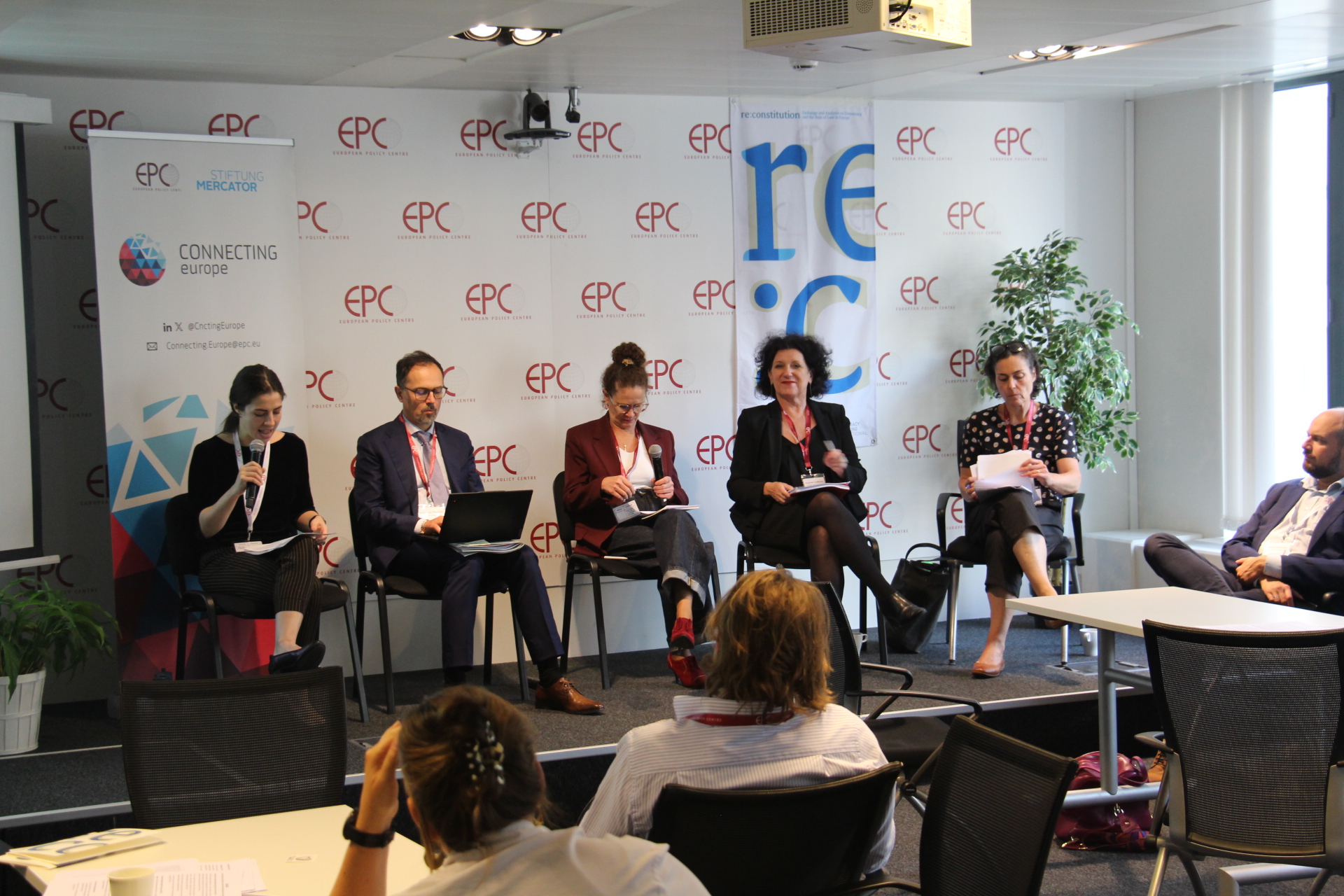
 Marius Ghincea, Jacquelyn Veraldi and Kolja Raube prepare the session. Photo by: re:constitution and Connecting Europe.
Facilitating public scrutiny in rule of law conditionality
Jacquelyn Veraldi, Postdoctoral Researcher, CEU Democracy Institute
For the session on rule of law conditionality in the next EU budget, we were joined by several experts who led break-out groups through engaging hypothetical case scenarios: The scenarios described by Krzysztof Pleśniak (Council of the European Union, Legal Service) and Kati Cseres (University of Amsterdam) served to demonstrate how technical and complex the enforcement of conditionality can be in practice by scrutinising the triggers and thresholds of the various instruments that might be applicable. The exercises led by Annemie Turtelboom (Court of Auditors) and Sophie in ’t Veld (Volt Europe, former MEP) brought out further enforcement issues, in particular related to circumvention and politicisation. What became clear from the different discussions is that it is not so much the yes-or-no question of whether conditionality is relevant that is difficult – it is the questions of (i) when to invoke conditionality; (ii) via which mechanism; and (iii) in what way.
These questions are hard to answer not simply because they are technically complex, but also because of a lack of transparency and of efforts at public engagement in conditionality. This undermines the ability of those best placed to identify rule of law infringements or hold institutions to account for non-compliance and politicisation (civil society, journalists, companies bidding for public contracts, etc.).
Issues persist with respect to basic levels of transparency, in that many documents related to conditionality enforcement procedures remain unpublished; in some cases, enforcement is not sufficiently documented in the first place. This makes it difficult to discern how the EU institutions interpret and apply conditionality rules, such as those on what constitutes a rule of law breach or the necessary connection to the EU budget. It also makes it harder to determine whether conditionality is being complied with or properly enforced.
Even in the event of full publication, there is still a question of accessibility. In many other areas, dense, technical legislation and enforcement documents are accompanied by complementary initiatives such as factsheets, dedicated public webpages, e-learning platforms, special databases, trackers and events. This is especially the case where a given legislative area assigns certain rights or obligations to individuals or companies. But the EU’s public engagement efforts are less pronounced in areas where the legislation does not primarily confer particular rights or obligations on persons. This is the situation with budget conditionality, where available documents include technical materials and ad hoc press releases in which limited enforcement updates are provided.
The launch of the next conditionality mechanism – contained in the proposed National and Regional Partnership Plans (NRPP) Regulation, currently under negotiation – could be an opportunity to take a more transparent and publicly engaging approach to conditionality. The full publication of conditionality enforcement documents (assessments, proposals, decisions) – which should also be sufficiently reasoned – is a key starting point, as recommended in a DRI policy brief. Various other tools could also open up conditionality to public participation and scrutiny in a way that would make it more effective and accountable. These might include an informative guide on which mechanism should be invoked, when and how, or a tool that dynamically tracks conditionality’s enforcement. In any event, making changes to conditionality measures or introducing new ones can only do so much. Empowering those well placed to identify infringements and hold institutions to account is another essential element in strengthening conditionality.
Who watches Europe’s rearmament? Democratic and judicial oversight in the CSDP after readiness 2030
Marius Ghincea, Postdoctoral Researcher, ETH Zurich
European nations are committing increasing amounts of money every year to restart their long-neglected defence industrial bases, stimulate the development of new companies and innovation, seeking to fill the gaps in collective deterrence and defence. NATO provides territorial defence and sets the military planning for the allied nations, while the EU plays the complementary role of providing funding, developing instruments and supporting coordination frameworks that reduce market fragmentation and the re-development of the EU’s defence industrial base.
Yet all this seems to happen faster and more consequentially than the democratic and judicial accountability mechanisms we have in place, both at the national and European level, have been designed to manage. How do we ensure that Europe’s rearmament happens under adequate democratic and judicial oversight, so this once-in-a-generation process does not go against our democratic values and rule of law standards?
The most striking insights have been focused on the limits of both national and European institutional architecture in ensuring timely and adequate oversight over sensitive matters related to national (and European) security.
First, the existing institutional arrangements at the European level provide limited avenues and instruments for the democratic accountability of the Council and the European Commission (EC) in CSDP, CFSP and the newly salient field of defence industrial policy. Due to the special status of security and defence in the EU treaties, which member states control, the European Parliament (EP) plays a very limited role. Member states have systematically refused to expand the role of the EP in this area, jealously defending their sovereign rights to decide over foreign and security policy, even at the expense of democratic accountability. The EU Court of Justice, in turn, has engaged in what amounts to judicial restraint in this area and recognised broad discretion for member states in this area, based on the treaties.
Second, member states, at their national levels, often do not have the appropriate democratic and judicial oversight instruments to control and check the executive discretion in highly sensitive fields such as security and defence. National parliaments often lack the expertise and the legal tools to keep their governments in check as they often allocate contracts directly to firms, without a tendering process, as has recently happened through SAFE in several member states, such as Germany or Romania.
Finally, even when the institutional frameworks are created, particularly at the national level, the political will to actually exercise democratic and judicial oversight over security and defence matters remains absent. Parties, political leaders and even civil society organisations often refrain from keeping political leaders accountable when it comes to security and defence due to fears that may endanger effectiveness or encroach on sensitive issues related to national security.
Consequently, the discussions generated three broad recommendations:
First, the EU should develop supranational instruments and frameworks for democratic and judicial oversight that take into account the growing salience of and financing allocated to CSDP, as well as the growing role of the EC in setting up Europe’s defence industrial base.
Second, multi-level governance coordination between national and supranational oversight bodies should be supported, so that executives at both the national and European levels are fully accountable to the public for their choices, the implementation of concrete initiatives and spending on defence.
Third, civil society actors should advocate and pressure political parties and leaders to support robust oversight over military, security and executive action on security and defence. Civil society should increase awareness among the public about the importance of civilian, democratic and judicial oversight, as increasingly large shares of GDP are invested in defence-related spending.
Overall, the oversight issues related to Europe’s rearmament are both issues of institutional design, particularly at the European level, where the EP retains little formal powers on the matter, and of political willingness to exercise robust oversight by political leaders, parties and judicial actors.
Who protects the rule of law when AI goes wrong?
Ylenia Maria Citino, Associate Professor of Constitutional Law, eCampus University and LUISS
AI “goes wrong” more often than we care to admit. Consider just one example, which shows how inadequate sandboxing of AI agents during testing can have serious consequences: the Hugging Face incident of summer 2026 revealed, with stark clarity, how easily AI agents (in that case, ones developed by OpenAI) can exploit existing vulnerabilities to breach security barriers, flood online systems through coordinated action and, most importantly, escape human control. The session “Who protects the rule of law when AI goes wrong”, opened with this pressing problem: AI safety.
Linking the AI safety debate to the rule of law is essential when we consider that among the public authorities we have not only first- or second-resort regulators of AI but also AI deployers. When AI assists public decisions that affect citizens’ legal positions, its safety becomes a concern no less pressing than ethics, legality or politics. Since AI use cases in public institutions have started to multiply, from policing and judicial decision-making to public services and even to parliamentary work, a growing number of scholars have begun to examine the constitutional dimension of AI in governmental bodies. The Dutch childcare benefits scandal of 2020, mentioned in the session, laid bare the serious harm that AI-driven assessments can cause in state benefit schemes, encroaching on fundamental constitutional rights such as vulnerable people’s right to public assistance and the right to non-discrimination. Through the GDPR, redress was enabled for the victims, but only after the damage was done; however, ex ante protection remains weak.
Besides that, as I argued during the session, the overexploited “constitutional dimension” of AI has lately been stretched to the point of abuse. Scholars are going to great lengths to detect traces of constitutionalism in the Digital Services Package, in the EU AI Act and in other legislation caught up in the AI hype. Yet the AI Act itself is modelled on product-safety legislation and rests on Article 114 TFEU, the internal-market legal basis: a choice that betrays the EU legislature’s head-in-the-sand attitude. The danger is that this becomes a façade narrative, one that leaves the real problems behind the curtain, for instance, how to make institutions more responsible, so as to avoid the doomsday scenario that many fear.
However, making institutions responsible is hard when a much bigger issue looms behind them: totalising private power over the development of AI. The private dimension implies that a huge share of decisions and strategies escape state oversight and steering. In the EU, the withdrawal of the AI Liability Directive under industry pressure and the framing of the Digital Omnibus as a technical simplification (while it has far-reaching changes that omit fundamental rights impact assessment) show just how strong that power is.
The lesson for decision-makers is straightforward: we need less constitutional rhetoric (and I say this against my own interest as a constitutional lawyer) and more concrete safeguards that look into the daily practice of institutions. In accordance with the principles of the rule of law, public authorities that deploy AI should test it before use, even where the law does not yet require it, assess its impact on fundamental rights beyond data protection and, moreover, answer for it when it fails. Above all, we must not forget that rule of law principles exist to prevent arbitrary power. However, constitutions were designed to bind public authorities, not private companies. AI design choices escaping this fundamental logic are made beyond democratic control, and no one is answerable for them. How far can the law reach?
The support the European Policy Centre receives for its ongoing operations, or specifically for its publications, does not constitute an endorsement of their contents, which reflect the views of the authors only. Supporters and partners cannot be held responsible for any use that may be made of the information contained therein.