

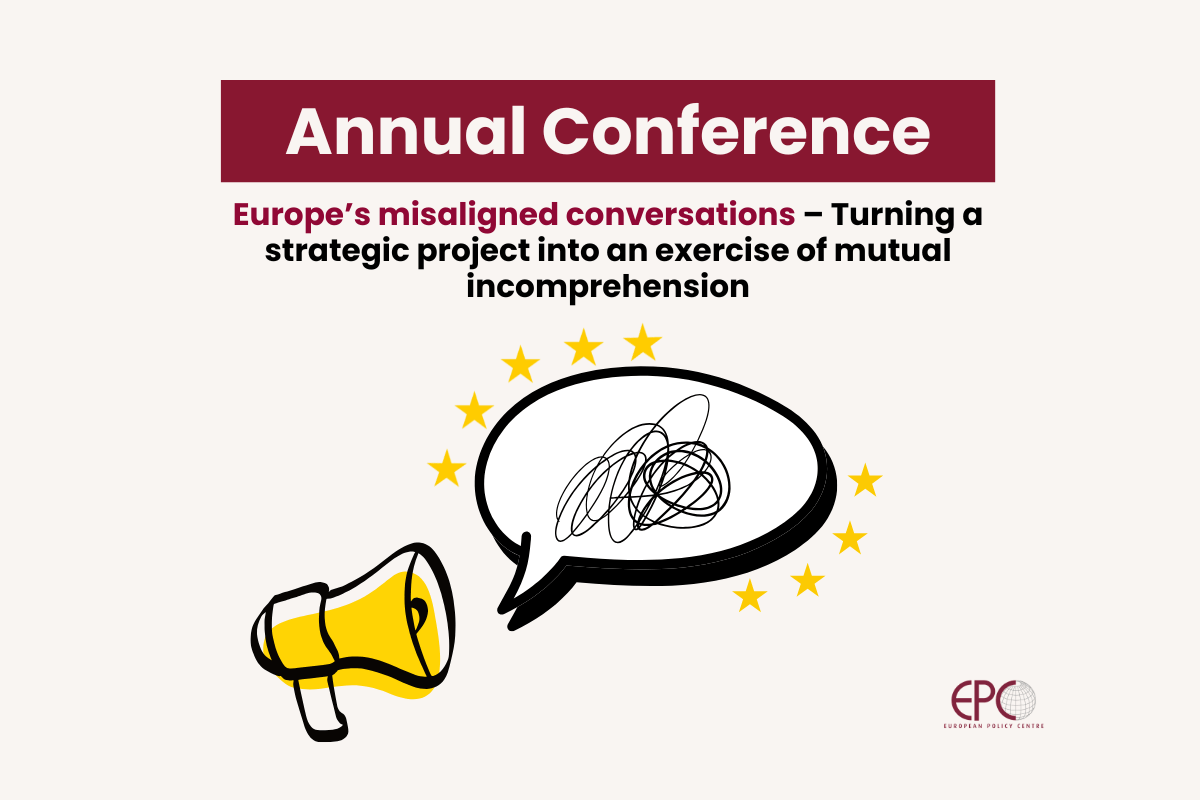
Europe’s misaligned conversations – Turning a strategic project into an exercise of mutual incomprehension
Charles Duhigg’s book Supercommunicators makes a deceptively simple point: progress depends less on how much is said than on whether the conversation is shared. When one side believes it is having a practical discussion (about problems and solutions), another an emotional exchange (about values and fears) and a third a social debate (about identity and belonging), the problem is not disagreement but misalignment. Responding to an emotional appeal with technical facts or treating a plea for recognition as a policy dispute, leads only to stalemate.
This insight applies uncannily well to the European Union (EU). Much of Europe’s gridlock – on enlargement, internal reform, migration, the environment, or countering populism – stems not from a shortage of ideas or instruments but from chronic confusion about the kind of conversation taking place. The EU speaks the language of procedure and precision, while its citizens, candidates and critics speak that of belonging, fairness and feeling. The result is a dialogue of the deaf that breeds frustration and weakens cooperation.
Enlargement: conditionality versus belonging
Enlargement is framed in Brussels as a practical exercise in compliance – about benchmarks, chapters and absorption capacity. For aspiring members, however, it is an emotional and social conversation about recognition, security and dignity.
When existential aspirations meet technocratic checklists, connection frays and momentum fades. The outcome is not simply slowed progress, but a loss of faith in the process itself.
Reform: efficiency versus trust/sovereignty
Internal EU reform suffers a similar mismatch. Reformers see it as an engineering task – how to adjust voting systems, streamline decision-making or revise treaties. Yet for many member states it is an emotional and social conversation about sovereignty and trust.
The clash between efficiency and control is not just political; it reflects the trade-offs Europe is not able to openly articulate. This is why reform talk often triggers defensive reflexes or polite silence.
Migration: management versus dignity
Migration is another case in point. Policymakers treat it as a management issue – flows, quotas and border regimes. The debate revolves around efficiency and burden-sharing mechanisms. Yet citizens experience it as an emotional and social conversation about security, fairness and identity: who belongs, who decides, and what solidarity means. For migrants, it is a human conversation about hope, safety and dignity.
No policy calibrated in numbers can soothe existential anxieties, however balanced it appears on paper.
Climate: transformation versus imposition
The climate agenda faces the same trap. Brussels speaks of transformation, targets and innovation. Communities dependent on carbon-intensive industries hear disruption and imposition. For them, it is a social and emotional debate about survival and fairness. Climate sceptics and populists exploit the gap to mobilise resentment. Miscommunication arises not because people reject sustainability, but because they feel excluded from the conversation.
Populism: facts versus feelings
The struggle against populism further exposes this dissonance. Mainstream parties speak in legal and procedural terms – defending the rule of law and fiscal stability – while radicals conduct emotional and social conversations about identity, fear and grievance. They offer belonging where technocracy offers procedure. Once again, facts meet feelings – and lose. And each defeat leaves liberal democracy weaker.
Towards a new European conversation
Europe’s failure is not just political or procedural but conversational. EU Institutions assume they are discussing policy; most citizens experience it as a question of purpose. The Union’s default idiom – technical, cautious and managerial – has created an empathy gap at the heart of the European project. This is not an argument for abandoning rigor or evidence, but for aligning the form of dialogue with the nature of the issue.
The next stage of European integration will demand more than institutional engineering. The EU institutions and member states must learn to be supercommunicators – able to distinguish between conversations about policy, values and identity, and fluent enough to connect them. This also means becoming honest about trade-offs: between speed and consensus, depth and breath, solidarity and sovereignty – and managing rather than denying them.
Otherwise, Europe will remain eloquent in procedure but mute in persuasion. Unity, if it is to endure, needs shared meaning as much as shared rules – only then can the EU continue to turn diversity into strength.
This commentary forms part of a series leading up to the European Policy Centre's 2025 Annual Conference. Click here to learn more.
Corina Stratulat is an Associate Director and Head of the European Politics and Institutions Programme at the European Policy Centre.
The support the European Policy Centre receives for its ongoing operations, or specifically for its publications, does not constitute an endorsement of their contents, which reflect the views of the authors only. Supporters and partners cannot be held responsible for any use that may be made of the information contained therein.