

After Orbán: why Péter Magyar would not be an easy partner for the EU
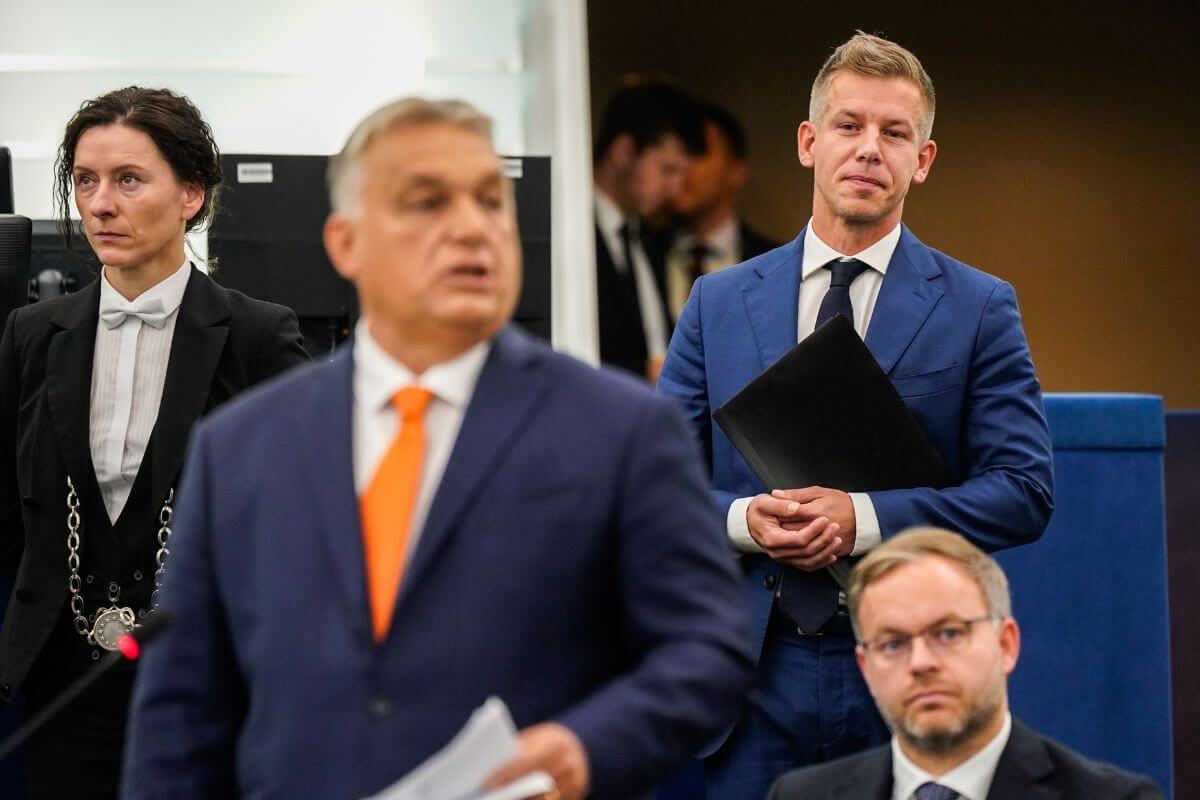


Péter Magyar, the Hungarian politician most likely to defeat Viktor Orbán, promises “regime change” but signals continuity on several core policies. The European Union should manage expectations and prepare for a more complex relationship than a simple post-Orbán reset.
With less than two months to go before Hungary’s 12 April elections, the Tisza party led by Péter Magyar is polling ahead of Orban’s Fidesz. For the first time since 2010, a change of government appears genuinely possible.
The stakes are high. A fifth consecutive term for Orbán would further entrench what the European Parliament has described as a “hybrid regime of electoral autocracy” at the heart of Europe, and reinforce Budapest’s capacity to obstruct common EU positions, including on security. But Orbán’s defeat would not automatically translate into smooth relations with Brussels.
This raises the question of what a Magyar-led government would look like in practice. A former Fidesz member and government official, and the former spouse of Orbán's ex-EU Affairs and Justice Minister, Magyar entered politics in early 2024. Running on an anti-corruption and anti-state-capture platform, his party won nearly 30% of the vote in the European elections, securing seven MEPs and joining the centre-right European People’s Party (EPP).
Regime change without full rupture
Tisza’s manifesto, published in early February, outlines a broadly pro-European trajectory. The party says that it “chooses Europe”, pledges to rebuild trust with EU and NATO allies and commits to joining the eurozone by 2030. Restoring the rule of law is framed primarily as a means to unlock €18 billion in EU funds currently frozen over systemic violations.
Yet EU leaders should not assume that a Magyar government would mark a clean break with Orbán-era policies. On Ukraine, Tisza’s manifesto is notably thin, beyond opposing Ukraine’s accelerated accession. Magyar has repeatedly stated that he would not reverse Hungary's current policy of non-support. While he signals an intention to reduce dependence on Russia, his proposed timeline – by 2035 – falls well behind the EU’s 2027 target. Tisza further opposes the Commission’s proposal for the next EU multiannual financial framework (MFF), arguing that it disadvantages Hungary, and rejects the EU migration and asylum pact.
Tactical alignment with Fidesz
This ambivalence is reflected in Tisza’s voting behaviour in the European Parliament. An analysis of Tisza’s voting record in the European Parliament done by Eulytix for the EPC shows that while Tisza MEPs are mostly aligned with pro-EU forces, they also engage in tactical alignment with Fidesz on politically sensitive issues such as Ukraine, agriculture and migration.
Since the start of the current parliamentary term, Tisza has aligned with the EPP in 84.3% of votes, with Renew Europe in 75%, and with the S&D in 64%. It voted like the European Conservatives and Reformists (ECR) in 62% of cases. Convergence with the far-right Patriots for Europe is lower, at 44%, and below Tisza’s alignment with the Greens (52%).
Figure 1: The distribution of alignment with Fidesz by political group (measured by percentage of votes similar to those of Fidesz)
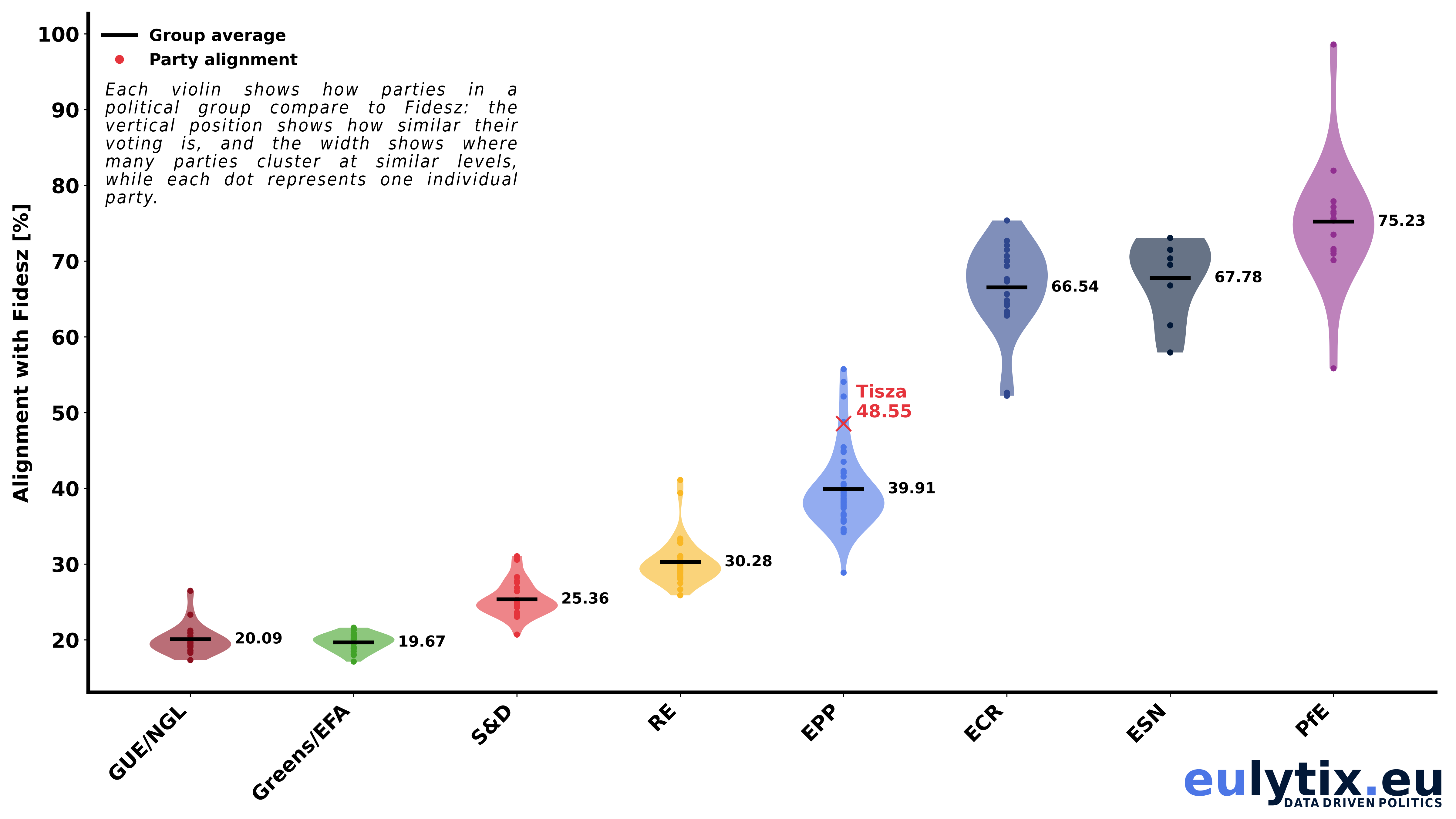
However, compared to other EPP delegations, Tisza ranks as the fifth most aligned with Fidesz (48.55%) – behind the French, Slovenian and Slovak delegations, and one Dutch party – above the group average of 39.9% and placing it to the right of the EPP mainstream. Vote-by-vote analysis suggests that this convergence is strongest on issues where Magyar is vulnerable to Orbán’s central campaign narrative portraying him as Brussels’ “puppet”.
The analysis finds that Tisza MEPs converged with Fidesz in resisting further institutional integration, favouring a security-first migration policy and opposing language on rights and equality. They joined Fidesz in voting against an amendment calling for stronger use of the Article 7 rule-of-law procedure. On Ukraine, they repeatedly voted against amendments that strengthened language on support for Kyiv and condemnation of Russia.
Figure 2: Distribution of topics across roll-call voting sessions where Tisza aligned itself with Fidesz in opposition to the EPP
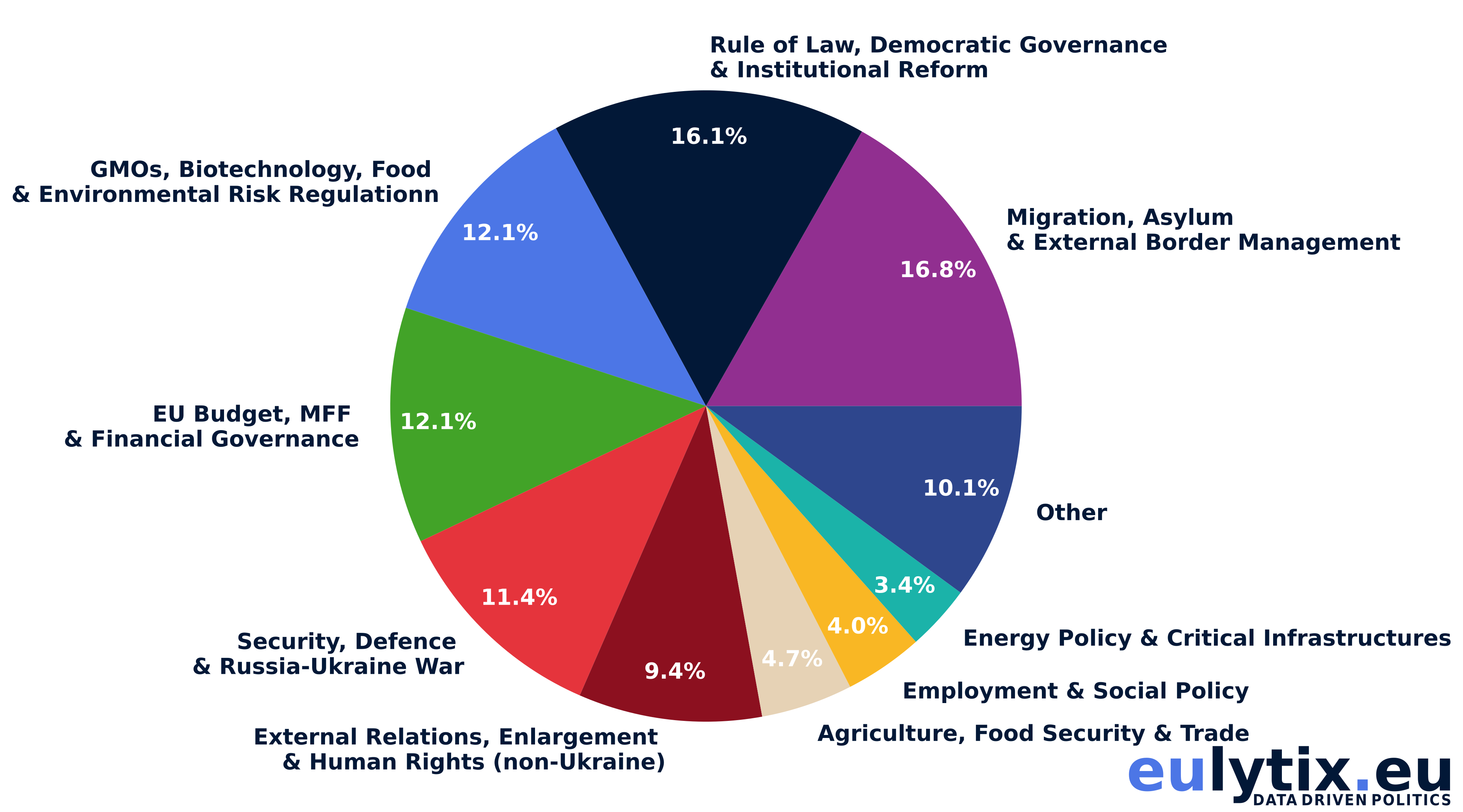
Source: Eulytix via European Parliament.
In more than half of cases where Tisza diverged from the EPP and aligned with Fidesz (52.5%), it did so through abstentions. This suggests caution rather than conviction: an attempt to balance pro-EU credibility with domestic Fidesz-aligned electoral positioning. Participation rates also point to limited engagement at EU level. Tisza MEPs took part in 53.5% of votes this term, compared with an 88% average across Parliament. Magyar himself participated in only 25%.
Tisza’s voting record and campaign rhetoric reveal a dual constraint. Magyar’s political instincts remain partly shaped by years inside the Fidesz system, while his position as a political alternative may be too fragile to permit a decisive rupture. A narrow electoral victory on 12 April, combined with Fidesz’s entrenched media dominance, economic networks and parts of the state apparatus, would further limit the room for manoeuvre.
Engage, but avoid misplaced assumptions
For the EU, the implication is clear. Orbán’s defeat would be symbolically significant, but it would not automatically resolve Hungary’s tensions with Brussels. Expectations should be calibrated accordingly. Early and sustained engagement would be essential to test Magyar’s intentions, understand his domestic constraints and shape incentives for genuine change.
Magyar, for his part, would need to invest quickly in relations with EU leaders and assert political autonomy from Fidesz framing. His political family, the EPP, would also bear responsibility for striking the right balance: supporting democratic reintegration without lowering the bar on EU values and security interests.
Orbán’s system has become a reference point for illiberal actors across Europe. A transition back toward an EU-integrated liberal democracy remains possible – but it should not be taken for granted, nor squandered by misplaced assumptions.
Eric Maurice is a Policy Analyst in the European Politics and Institutions Programme at the European Policy Centre.
Levente Kocsis serves as Chief Data Scientist at Eulytix.
Eulytix has been supported by the National Research, Development and Innovation Office in Hungary under the project number 2021-1.1.4-GYORSÍTÓSÁV-2022-00041.
The support the European Policy Centre receives for its ongoing operations, or specifically for its publications, does not constitute an endorsement of their contents, which reflect the views of the authors only. Supporters and partners cannot be held responsible for any use that may be made of the information contained therein.