


NATO is asking whether the United States under Donald Trump is still reliable. The answer is simultaneously: yes, no, maybe.
Schrödinger’s cat is the best-known image of indeterminacy: inside the closed box, the cat is both alive and dead. NATO now faces a similar ambiguity. Is the United States still reliable? Under Donald Trump, the most honest answer is simultaneously: yes, no, maybe.
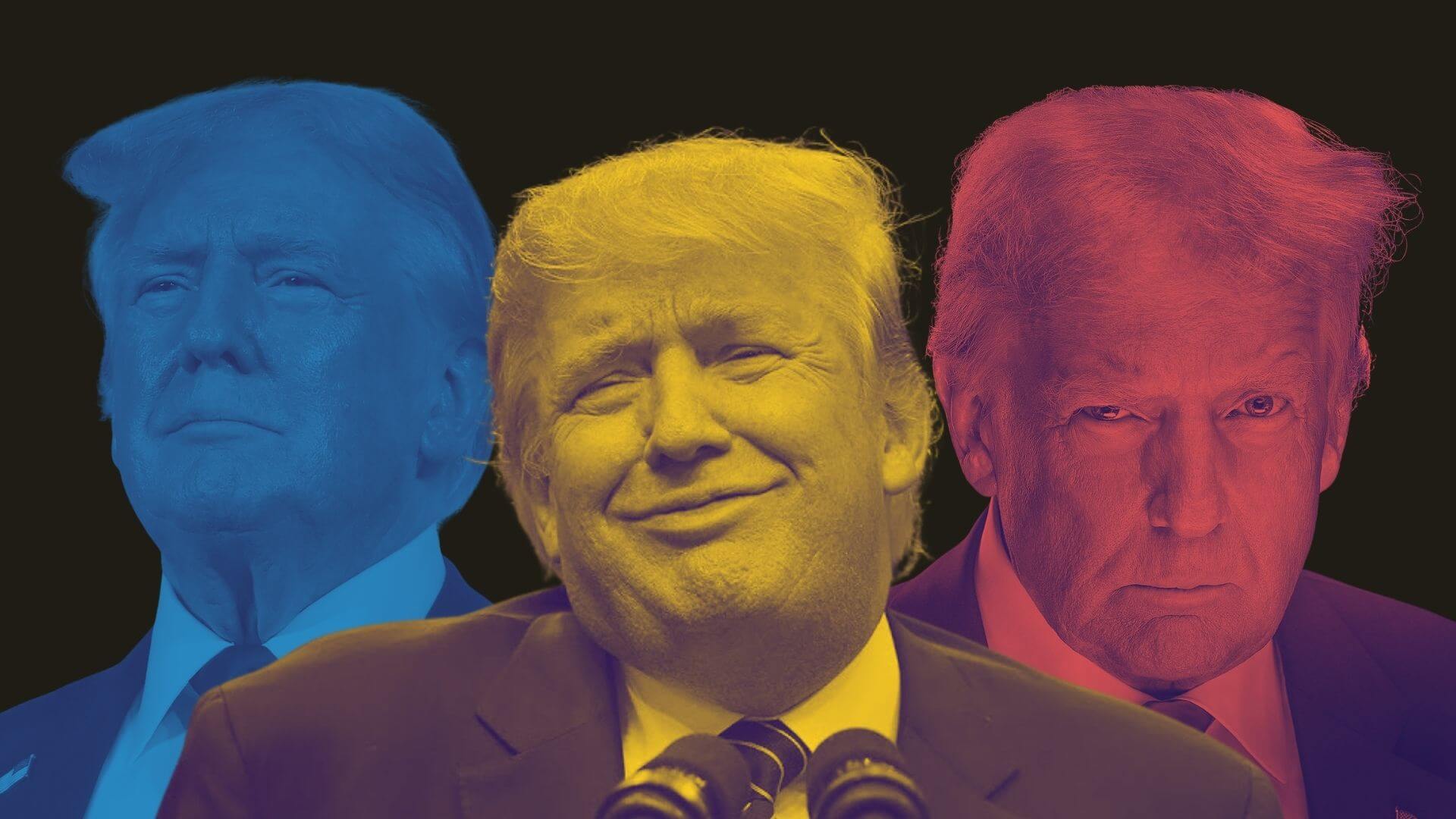
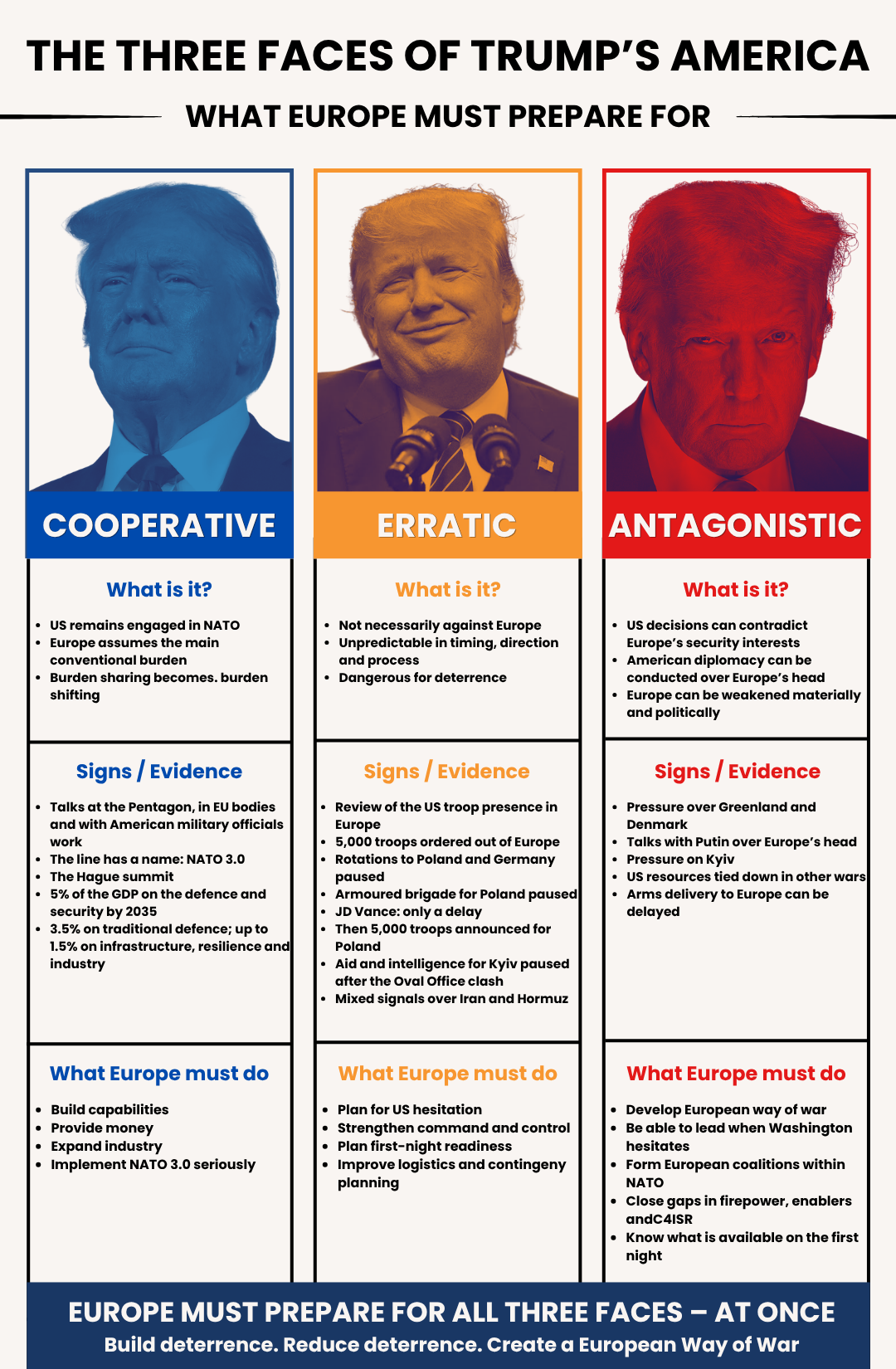
Europe’s strategic problem is that United States simultaneously shows three faces: a cooperative one, an erratic one and an antagonistic one. All three can be substantiated. None can be ruled out. And no one in Europe knows reliably which face will prevail in a crisis.
This is where Europe’s problem begins: it clings to the story of a cooperative United States and treats disruptive events as exceptions. Those who point out that Europe must be able to defend itself even without the United States often hear that doing so would drive Washington away. The result is a dangerous assumption: That the American security guarantee will hold as long as Europe behaves correctly.
The three faces
The cooperative Trump
In fact, European officials can point to areas that are working well: talks at the Pentagon, in NATO bodies, and with American military officers, officials and advisers. This cooperative line now has a name that many repeat hopefully: NATO 3.0. What is meant is an alliance in which the United States does not disappear, but in which Europe assumes the main conventional burden. Burden sharing becomes burden shifting: not as a rupture, but as an orderly transfer of responsibility.
On this reading, the development began with the NATO summit in The Hague – and everyone agreed. In 2025, allies decided to spend 5% of gross domestic product annually on defence and security-related expenditures by 2035: 3.5% on traditional defence, and up to 1.5% on infrastructure, resilience and industry. For proponents of this interpretation, that was the proof: Trump is not destroying NATO. He is forcing it to mature.
This interpretation is incomplete. It assumes that European performance stabilizes Trump’s behaviour. If Europe pays, delivers, buys, builds and tones down its rhetoric, so the story goes, America will remain reliable. But this lever has not been proven.
Europeans cannot answer the decisive question: How would Donald Trump decide if the German Chancellor called him today asking him to support Article 5 and send US troops? The same diplomats would then have to admit that none of their American counterparts has reliable access to the White House or knows how Trump’s decisions are made – or how to influence them. Yet as commander-in-chief, Trump has the final say over the use of American forces.
The erratic Trump
By now, there are just as many examples pointing to the second face. This Trump is not necessarily anti-European. He is unpredictable in timing, direction and process. That is precisely what makes him dangerous for deterrence.
The troop-withdrawal debate illustrates this better than any abstract formula. Washington had reportedly been reviewing the American troop presence in Europe. Then came Trump’s early May order that the US presence in Europe be reduced by around 5,000 troops. Then came signs of reductions in capabilities in Germany and a halted rotation of around 4,000 soldiers to Poland. Shortly after, Vice President JD Vance said it was only a delay. Then Trump personally announced that the United States would send an additional 5,000 troops to Poland. The result was not a discernible line, but confusion: troops out of Germany, troops not going to Poland, then troops going to Poland after all.
For European deterrence, this sequence is toxic. Adversaries must believe that American capabilities will be politically available in an emergency. If no one can say whether a troop movement is orderly burden shifting, punishment for political criticism, an administrative act by the Pentagon, or a presidential about-face, American power remains visible on the map but becomes less reliable within the alliance.
Ukraine policy followed the same pattern. After the Oval Office confrontation with Volodymyr Zelenskyy, the United States paused military aid and intelligence cooperation with Kyiv. A personal conflict in the White House had immediate consequences for Europe’s security.
Iran shows the same logic. First, European allies were pressured to support American operations around the Strait of Hormuz. They refused. Then Trump declared that NATO was not needed. A conflict outside Europe became a test of alliance loyalty.
The antagonistic Trump
The third face is even more uncomfortable. In this scenario, America is not merely uncertain or volatile. Individual decisions directly contradict European security interests.
Greenland is the clearest case. If an American president seeks control over a territory that belongs to the Kingdom of Denmark, that is not merely theatrics. It touches the core of the alliance. NATO states suddenly have to consider how they would respond to pressure not from Moscow or Beijing, but from Washington.
Ukraine and Iran also reveal the antagonistic face. If Washington talks with Putin about a postwar order while Europe is pushed to the margins and Ukrainian security becomes a bargaining chip, the problem is not only American withdrawal, but American diplomacy conducted over European security. If, at the same time, arms deliveries are delayed because American resources are tied down elsewhere, Europe’s security declines in material terms.
Europe must plan for all three Trumps
Europe must not choose the scenario that hurts the least. The cooperative Trump exists. The erratic Trump exists as well. The antagonistic Trump is at least possible. For that reason, it is not enough to be reassured by functioning conversations within the machinery of government.
For the cooperative Trump, Europe needs capabilities, money, industry and a serious implementation of NATO 3.0. For the erratic and antagonistic Trump, that is not enough. For those faces, Europe needs a European Way of War.
This does not mean a romanticised EU army, but European war-fighting capabilities: Who leads when Washington hesitates? Who decides on escalation, operations and risk-sharing when the American president does not answer the phone? Which European coalitions can act within NATO, but without American leadership?
A European Way of War begins not with procurement, but with political leadership. Of course, Europe must close capability gaps – in firepower, enablers and C4ISR – that the US could leave. But the three faces imply that Europe must be able to act when the US chooses not to be involved. European leaders must be able to take decisions on war and peace independently of the US – and to have trained this decision-making in practice.
This is not a rejection of the United States. It is insurance against its unpredictability.
Schrödinger’s Trump describes a NATO that does not know which Trump would appear in a crisis. Europe’s task is not to guess the answer. It is to make the answer matter less.
Dr. Christian Mölling is Director of the think tank EDINA (European Defence in a New Age) and Senior Adviser at the European Policy Centre.
The support the European Policy Centre receives for its ongoing operations, or specifically for its publications, does not constitute an endorsement of their contents, which reflect the views of the authors only. Supporters and partners cannot be held responsible for any use that may be made of the information contained therein